3D · JP001VD
Drag to rotate · pinch or use + / − to zoom
Inspect the lid, hinge or sliding drawer in normal use.
A deep base and 20 mm lift-off lid with distinct paper-return depths on each pair of sides.
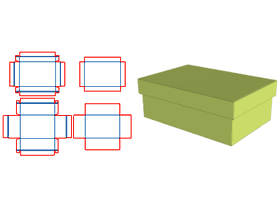
Neutral L, W and H are base board axes. Inside H measures base depth and outside H measures the closed assembly.
Complete closed assembly envelope: 159.8 × 109.8 × 53.95 mm
Inspect the lid, hinge or sliding drawer in normal use.
Outside artwork prints on wrapping paper. Inside artwork prints on lining paper. Greyboard remains a separate core.
Preview colours are separate from material caliper and print-ready colour specifications.
| Blank | Material | Caliper | Per set | Order blanks | Net area / set |
|---|---|---|---|---|---|
| Greyboard core | 2 mm | 1 | 100 | 0.0400 m² | |
| Outer wrapping paper | 0.2 mm | 1 | 100 | 0.0521 m² | |
| Greyboard core | 2 mm | 1 | 100 | 0.0275 m² | |
| Outer wrapping paper | 0.2 mm | 1 | 100 | 0.0361 m² |
Net areas exclude holes and overlaps between panels in the same blank. Stock sheets, waste and adhesive are separate.
Different calipers have independent sheet plans. Each component remains a distinct blank. Prepared greyboard uses the full rectangular stock for sheet yield.
Sheet sizes are format references; the model uses 2 mm material. Confirm stock, grain and availability in the quotation.
All materials selected for SVG, DXF and OBJ. Animated glTF and the editable record contain the complete assembly.
The 20 mm cover depth is D1. The base returns are 20/9 mm, and the cover returns are 18/4 mm. Four cut-cross and paper blanks are kept separate. Neutral hinge planes are rebuilt from the selected material gauges. Captured source cut and wrap extents are retained separately where the source groove and paper allowances differ. Machining profile, residual board skin, paper compression and adhesive buildup remain supplier settings. Check a physical sample before tooling.
Packmage drawings, dimensions, options and accessible 3D states are recorded per design. EasyPackMaker provides independent construction-family and material-fit comparisons. Matching codes do not prove matching physical designs.
Tooling grooves, residual skin, adhesive compression, hardware and physical fit still require a supplier sample. This is an independently editable construction, with source-specific differences recorded; factory equivalence is not claimed.